
A monthly bookkeeping checklist for a clear handoff to your bookkeeper

Let’s make the monthly routine easier to follow
You’ve sent over your statements and found most of the receipts. Then another month ends, and you’re wondering what still needs doing.
I’d start with one question: what do we have, and what are we still waiting for?
When you’re running a small business, bookkeeping can end up squeezed between customer work, staff questions, and everything else that needs you. A monthly bookkeeping checklist gives you somewhere to start each time, without having to remember the whole process.
You don’t have to do every task yourself. You do need to know which records to gather, which questions need your answer, and who is checking the books. Here’s how I’d work through it with you.
1. Start with this month’s records
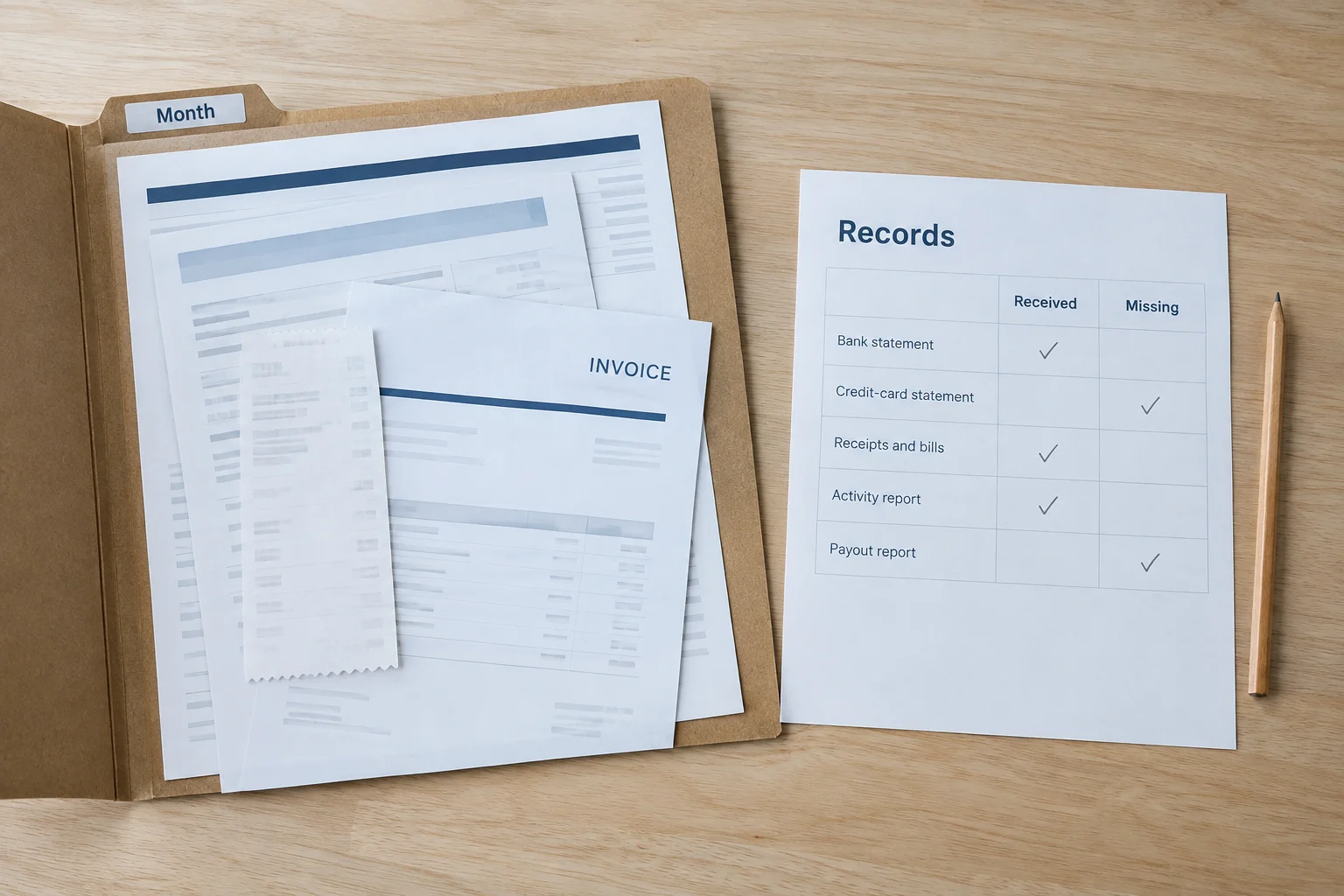
First, write down the month and the business accounts you used. Include bank accounts, credit cards, and any platform that collects customer payments.
Then gather what you have:
Bank and credit-card statements, with all pages.
Customer invoices and supplier bills.
Receipts for business purchases.
Payment-platform activity and payout reports, if you use them.
Keep the records in one place that you and your bookkeeper have agreed to use. That might be your existing folder or document-sharing system. You don’t need a new tool just to begin.
If something is missing, name it. “September credit-card statement still needed” is much easier to act on than “documents incomplete.” Send what’s ready and keep the missing item on your list.
Keep the receipts and bills, too. The IRS explains that supporting documents help establish what an expense was for. A bank entry can show that money went out without explaining what you bought.
2. Leave a note about anything you don’t recognize
Next, look for the payments that make you pause. Maybe you don’t recognize the supplier name. Maybe you remember the purchase but can’t find the receipt. Or two entries look like the same payment.
You don’t need to guess. Leave a short note with the date, amount, account, and your question. “I think this was a transfer to the savings account—can we check?” gives your bookkeeper something useful to work with.
Here’s a simple example. Your payment platform shows $1,000 in activity, but the bank deposit is $970. The $30 difference needs an explanation. Fees, refunds, or timing could be involved; check the records before deciding.
If you use Stripe with automatic payouts, its payout reconciliation report can help connect the deposit to the transactions included in it.
While you’re there, check customer invoices and supplier bills that still appear unpaid. Has a customer paid you recently? Did you pay a bill from another account? Share those details so the records can be checked.
3. Ask which accounts have been reconciled
This is where I’d slow down for a moment. Seeing transactions in your software doesn’t tell you whether someone has checked them against the statement.
That comparison is called reconciliation. Intuit’s reconciliation guide explains it as matching recorded transactions with bank or credit-card statements and investigating differences.
You don’t need to memorize the accounting language. Ask your bookkeeper: “Which accounts are finished for this month, and which ones still need something from me?”
Keep the answer beside each account on your checklist. If a difference is still being investigated, leave that account open. A matching bank balance also doesn’t tell you whether every purchase has the right category or enough supporting detail.
If you’re the person doing the bookkeeping, give yourself the same check. What period did you compare, and is there anything you still need to explain?
4. Talk through the numbers and the next steps
Once the records have been reviewed, take a look at the reports that fit your business. You don’t need to understand every line before asking a useful question.
A profit and loss report shows recorded income and expenses for a period. Start with anything that surprises you. Does an expense look unusually high? Does income look lower than you expected?
Ask what is behind the figure and whether missing information could still change it. The point is to understand what you’re looking at, including what isn’t finished yet.
If that conversation is where you need support, our reporting support for business owners describes the focus on a clear monthly view and plain-English communication.
Before you finish, make each next step specific. “I’ll find the supplier invoice by Thursday, then you’ll check the entry” is easier to follow than “we’ll look into it.” Agree on who is doing what and when you’ll check back.
Keep this monthly bookkeeping checklist handy
Copy this table for each month. Put a name beside each task, then use the last column for the record, answer, or follow-up that is still needed.
Month: [month and year] | Accounts: [list the accounts]
What to check | Who is handling it | Still needed |
|---|---|---|
Gather statements, receipts, invoices, bills, and payment-platform records. | [name] | [missing records] |
Explain unfamiliar payments and identify transfers. | [name] | [questions to answer] |
Check unpaid invoices and supplier bills. | [name] | [payment details] |
Review transactions and reconcile each account. | [name] | [accounts or differences still open] |
Talk through the reports and agree on the next steps. | [name] | [action and follow-up date] |
For reconciliation, use a separate line for each account so you can see which ones are finished. Keep the statement and reconciliation report together.
Gathering your records is one part of the work. Your bookkeeper may still be checking an entry or waiting for an answer after you’ve sent everything over. Leave that question visible until it’s resolved.
5. Bring unfinished questions into the next month
A new month doesn’t make an old question disappear. If you’re still looking for a receipt or checking a difference, bring it forward with the original month and the next step attached.
That way, you won’t have to search through old emails to remember what you were trying to sort out.
If older months keep getting in the way, start with our guide to getting caught up on bookkeeping. You can keep gathering current records while you work out what the backlog needs.
For now, start with one sheet. Write this month at the top and list the accounts it needs to cover.
If you’re not sure where this month stands, tell me which records you’ve gathered and what’s still missing. We can start there.
Sources
Payout reconciliation report | Stripe Documentation — Stripe
What kind of records should I keep | Internal Revenue Service — Internal Revenue Service
Balance Sheet vs. Profit and Loss Statement — QuickBooks